Mentorship initiative expands pathways into pediatric surgery

A national mentorship initiative aimed at improving representation in pediatric surgery is showing promising results, according to a new report on the Alliance of Pediatric Surgeons Growing and Advancing Representation (APGAR).
The report on the effort, which is led by CHEAR faculty investigator Samir Gadepalli, MD, MS, MBA, was recently published in the Journal of Pediatric Surgery.
Gadepalli said that APGAR was created to address longstanding gaps in mentorship and sponsorship for learners historically underrepresented in pediatric surgery. Recognizing that barriers often arise early in education, he said the program was designed to support participants across the entire training continuum—from high school students to practicing pediatric surgery attendings.
"There's a gazillion studies that show we don't have enough diversity (in pediatric surgery)," Gadepalli said. "Several years ago, I was like, "Okay, then let's fix that.
"There are several different stages of your career on your way to becoming a pediatric surgeon, and some people are going to fall off this train and go into other fields. But if I can help mentor them along the way, then there's a higher likelihood that they're going to increase the representation overall."
Gadepalli explained that pilot program implemented a structured, multi-tiered mentorship model built around longitudinal mentorship groups, known as "pods." Each pod included members at different career stages, allowing younger learners to gain exposure, guidance, and advocacy from peers and senior mentors. Pods met independently at least every three months and were supplemented by APGAR-wide virtual programming focused on key educational and professional development topics.
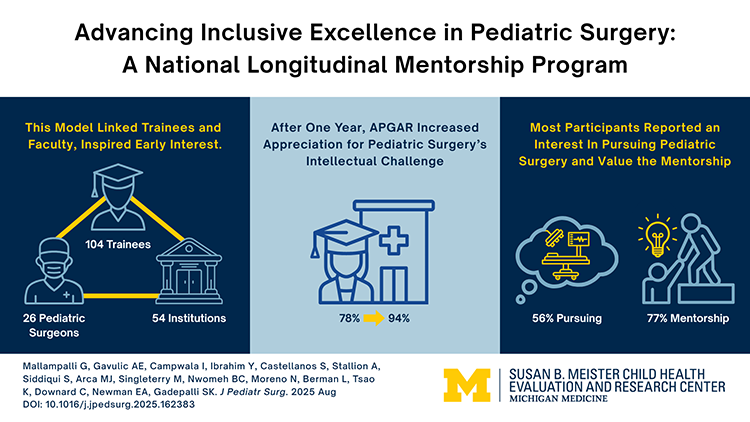
To evaluate the program's impact, researchers administered surveys before pod formation in the spring of 2022 and again one year later. In total, 17 pods were formed, involving 104 trainees and 26 faculty pediatric surgeons from 54 institutions. Survey respondents were predominantly students (70%) and women (80%), with racial and ethnic representation that included White (39%), Asian (26%), Black (18%), multiracial (10%), and Hispanic (6%) participants.
After one year, participants reported a significantly greater appreciation of the intellectual challenge of a career in pediatric surgery, increasing from 78% before the program to 94% at follow-up. More than half of respondents expressed interest in pursuing pediatric surgery, and over three-quarters emphasized the value of the mentorship they received through APGAR.
The report concludes that APGAR’s structured, virtual, and longitudinal approach successfully engaged learners and fostered early exploration of pediatric surgery careers. Participants consistently highlighted mentorship as a key factor shaping their perceptions, underscoring the importance of intentional, inclusive mentorship models in diversifying the future pediatric surgery workforce.
"We found that it really changed how people thought about pediatric surgery, "Gadepalli said. "It did a really good job of helping people decide if this is what they want to continue to do. And for those who did, it will continue to help foster their career development and growth. For those who want to leave, at least it gives them some underlying knowledge in terms of figuring out what to do with their life."